How to Know If You're Hiring a Real AI Expert

I asked him for the numbers. How many did he text. How many confirmed. How many were coming.
He could not give me the numbers. He had promised me the calls were made.
The event was the next day. I had already spent money on ads for that event.
So the day before the event, I built an AI to do it instead. It reached out to the leads and reminded them the event was the following day.
That system has now talked to 2,500 people. It cost me less than $2 to run. A couple of years earlier, in the Philippines, the same work would have cost me around $200 a month.
This post is about the day that system got built.
What made that system work?
It would be easy to read that as a story about AI beating a human. It is not.
The reason that system worked, with one day left before the event, is that I knew who needed to be called. I knew what needed to be said. I knew what I needed counted: how many he texted, how many confirmed, how many no-showed, how many were coming. It was my event. I ran the ads that filled it. I knew the outcome and I knew the process. The AI only did the part I had already defined.
Now hand that same problem to an expert who has never run one of my events. They will build you something beautiful. It will call the wrong people, with the wrong message, on time, at scale.
Hiring someone to do a role is not enough. That is not a new problem and it has nothing to do with AI. Michael Gerber gave the mistake a name.
What is the Fatal Assumption?
Gerber wrote about the technician. Someone who is great at the work, so he opens a business doing that work. The best baker in town opens a bakery.
Gerber called that moment the Entrepreneurial Seizure. And he gave the belief underneath it a name too. The Fatal Assumption.
It sounds like this. I am good at baking, so I am good at running a bakery.
He is not. Baking is the work. The bakery is the business around the work. He is great at one of those and has never been asked to do the other.
Two different jobs. He brought one.
Now read it again with AI dropped into it.
I am good at baking. So I am good at running a bakery.
I am good at AI. So I am good at any business.
That is the person quoting you a price right now. A lot of people use ChatGPT, a lot of people use Claude, but they do not really know what they are doing. They just see something cool and think they can replicate it in other businesses. There is no clear track record underneath it.
And there is a second version of this, and it is yours.
Gerber's technician hired people into roles that were never defined. You are about to hire an AI expert to build a system whose outcome you have not defined. Same move. Different decade.
Only hire someone when you already know the exact outcome and the process. Until you have that clarity, you are not buying help. You are buying a stranger's guess about your own business.
So what makes someone a real AI expert?
A real AI expert is someone who understands that the context is more important than the shiny new tool.That is the whole test. Everything below is how to check for it.
AI is so versatile. There are a lot of ways to use it. That versatility is exactly what lets someone who has only ever pointed it at one thing sound like an authority on all of them.
A fake expert will convince you that all you need is AI. That you do not need to fix any other aspect of the business. If you have problems with social media, all you need is AI to make your social media posts. The tool gets sold to you as a reason to never look at anything else.
Why does the same tool work for me and not for my client?
Here is the evidence I have.
The social media posts I make for myself are all AI generated. So are the Facebook ads. Those ads brought leads in at about 16 US cents each.
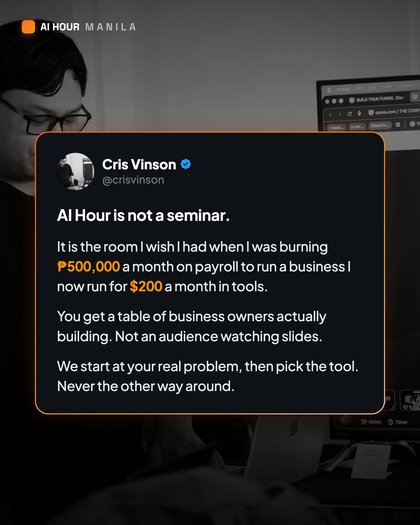

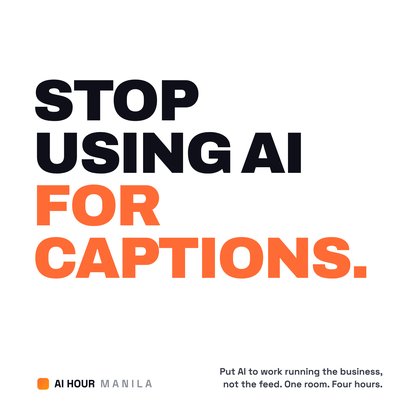
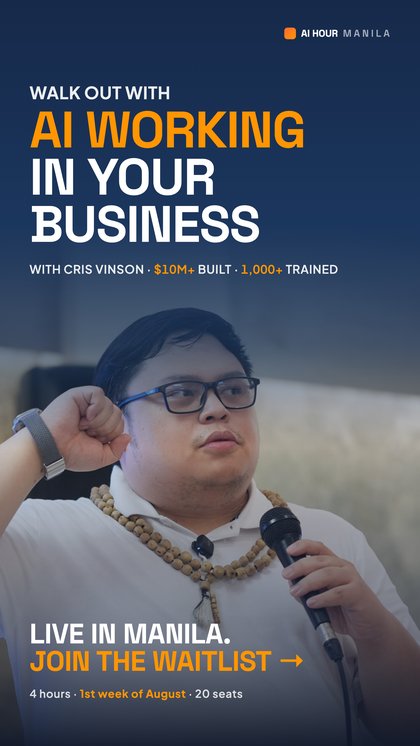
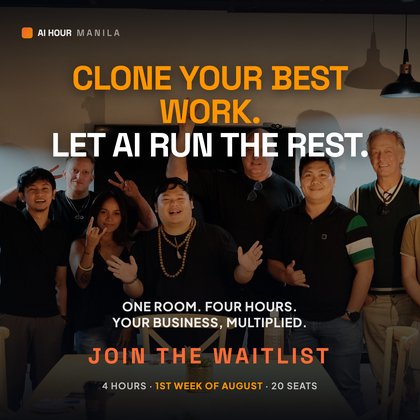
Look at what is in those ads. My payroll number. My photos. Me on a stage with a microphone. The first one is a post about the room I wish I had when I was burning ₱500,000 a month on payroll to run a business I now run for $200 a month in tools. The AI did not know any of that. I did. It was already sitting there, waiting to be poured in.

Now take a client of mine. Same operator, me. Same tools. I have a hard time making their posts, and their feed comes out sloppy.
Not because the AI is worse for them. Because they do not have enough context and social proof. I have more photos. I have more stories. I have a bigger story bank. I have a bigger context.
I could make their social media posts for an entire year out of one video. And their entire profile would still look sloppy. It would look AI generated. It does not help.
Same tool. Same hands. Different context. That gap is the whole argument, and no expert can close it for you.
Why does a survey not get you the facts?
So what should a real expert care about before they ever talk about tools? Context. Is the client informed? Do they know what they don't know? Do they have all the information we need? Is it grounded on facts and reality?
The best example I know is this. In organizations, a lot of people use surveys to tell whether the organization is healthy or not.
The survey does not get to the facts of the matter. Surveys rarely do.
The best way to get to the facts of the matter is by interviewing people. Actually going out there and talking to people.
An AI expert who has not done that inside your business is working from your survey. Everything they build sits on top of it.
Am I not one of these people?
I am one of these people. This is a post about hiring AI experts, written by an AI expert, telling you to think hard before hiring an AI expert.
So point the test at me.
Two years of it. Law firms, dental clinics, the backend of a U.S. dental marketing agency, events, thirty-odd landing pages. That is a résumé, and I just spent this whole post telling you a résumé is a claim you cannot see. So do not weigh that. Weigh what is already sitting in front of you on this page.
The follow-up system I opened with is still running. It has talked to 2,500 people and it has cost me under two dollars to run. The ads a few screens up brought leads in at about sixteen cents each, and I left the full teardown so you can pull it apart yourself. And then there is the number I signed off on every single month before I had built any of it.
Software engineers, social media people, funnel experts, GoHighLevel experts, multimedia experts, creatives, media, video editors, HR, admin. An entire department alone, running ₱500,000 to ₱700,000 a month.
That payroll was not buying output. It was buying inefficiency.
Every one of those, you can go check. That is the only kind of proof worth trusting, mine included, and it is the exact thing the guy who watched AI do something cool once cannot put in front of you.
A real expert would start by asking what the outcome is. That is where the test starts.
What is the Context Test?
Here are the five questions a real expert asks you before they name a single tool. Sit through a first meeting and count how many they ask.
What is the real outcome?
What is the real goal for you? Automating a system is sometimes not the real answer, and it is not the real goal of the client. Maybe it is more freedom. Maybe it is more time. An expert who takes "automate this" at face value is an order taker with a subscription.
What data do you already have?
What makes your hunch a thing? What made you think this was the problem in the first place? Where is the evidence for the problem you say you have? Is it grounded on facts and reality, or is it the version that fits in a form?
Have you talked to the stakeholders, and what is the honest goal?
The stakeholders are the people whose jobs this project touches. If the goal is to replace them, I at least want to know why. I will say the unpopular part out loud: at this stage I am pro replacing people if it means a business owner has more freedom. But I am not pro replacing good people. If the people working with you are good, I would decline the project.
Do the values line up?
What is your value, and does it align with mine? This one runs in both directions and most people skip it. An expert with no line they will not cross has no judgment to sell you, only labor. The judgment is the thing you are supposed to be buying.
What is this pain costing you?
How would I quantify the pain? How much is this pain costing you? Because sometimes a lot of owners would think, hey, AI can just fix this, I can do this myself. Chances are they don't really know what's going on.
Do they understand business, or just tools?
Ask what their experience is. If they are just working on what they are good at, there is a problem. There is a saying that tunnel vision does not give you perspective.
So they have no perspective. Here is what that costs you.
Human design means knowing how actual people behave. That is the thing perspective teaches you, and it is the thing tunnel vision costs them.
So they can design AI. They probably cannot design AI that will support the business. Because ultimately, the ones that pay are customers. People. That has not changed yet.
Then ask for a plan. A real expert should be able to create a detailed plan for you, and I do not expect that plan to be free. Some experts will even charge you for a consulting call and then charge you again for an implementation call.
I have a client with a good tech team. They just needed someone to point the tech team in the right direction. So that is what I did. I point the direction, I give them the frameworks, and they pay me a retainer to do just that.
That arrangement only works because they already have the team. What they were missing was the direction, so the direction is what they pay for.
Is anything future proof?
Then the ROI. You need to check long term. Is what you are creating going to be future proof?
Chances are it is not. If you have an expert who says don't worry man, this is going to be future proof for your business, that is not entirely true. I taught people something revolutionary two months ago that is not applicable now.
What you can do instead is harden it. That is how Anthropic does it: you harden the system and you harden the skill.
In plain words, you build it so the pieces come out. When the tool underneath changes, you swap that piece. You do not start over.
What are the red flags?
The expert pretends to be an expert. AI is not even real AI. It is just a large language model. And even me, as someone who has worked with so many businesses, there are so many things I still need to learn. Right now I am dabbling in how algorithms can help sort, how algorithms can make my agents smarter, so they become less wasteful for the environment.
They seem to know more about your business than you do. Chances are the AI expert telling you what to do needs a lot more context.
All you need is AI. You do not need to fix any other aspect. Problems with social media? Just use AI to make the posts. Notice the tool never asks you to fix anything else.
They promise it is future proof. Chances are it is not. It is the fastest way to find out someone has not been at this long enough to watch their own work expire.
No clear track record. They saw something cool work once and think they can replicate it in other businesses.
They take "automate this" at face value. Automating a system is sometimes not the real answer, and not the real goal. An expert who builds exactly what you asked, when what you asked was vague, will build you an efficient wrong thing.
Now the part that costs me money to say
You probably should not hire anyone yet.
Not because experts are bad. Because you are not ready to buy. You should only hire someone when you yourself know the exact outcome and the process. When you have enough clarity to hire someone.
The exact outcome
Not "use AI." The specific result, in one sentence, that you would recognize on sight if someone handed it to you.
The process
The steps that produce that outcome today, even if a human does them slowly and badly.
The cost of the pain
How much this pain is costing you. A number, not a feeling.
Clear all three and you can hire almost anyone competent and still get value, because now you are the context. You will know when the build is pointed at the wrong thing, because you already know what right looks like.
Miss them, and the best AI expert alive will hand you a beautiful machine pointed at the wrong problem. You will not know it is the wrong problem, because you never named the right one.
That day before my event, I did not have an AI expert. What I had was the exact outcome and the exact process, because it was my event and I had run the ads for it. That was the hard part. The AI was the easy part. It has talked to 2,500 people since, and it has cost me less than $2 to run.
Go get the clarity first. Then decide whether you still need to hire anyone. And do not get scammed by a tech guy.
Frequently asked questions
How do I know if an AI expert is legit?
A real AI expert asks about your business before they name a tool. They want to know five things. The real outcome you are after. What data you already have. Whether you have talked to the people inside the process. Whether your values line up. And how much the pain is costing you. If the first meeting has a product name in it and no questions about your business, you are being sold software, not expertise.
What is the biggest mistake business owners make when hiring an AI expert?
Assuming the AI expert knows more about their business than they do. Chances are the expert telling you what to do needs a lot more context. You know the customers, the offer, and what done right looks like. The moment you hand over that judgment because someone sounds technical, you have bought a stranger's guess about your own company.
Should I hire an AI expert or learn AI myself?
Neither, until you know the exact outcome and the process yourself. Once you have that clarity you can direct almost anyone, including yourself. Without it, the best expert alive will build the wrong thing well.
What are the red flags of a fake AI expert?
They pretend to be an expert and never say what they still need to learn. They promise the build is future proof. They tell you all you need is AI and you do not have to fix anything else. They have no clear track record, just something cool they saw work once. And they seem to understand your business after one call.
Is it normal for an AI consultant to charge for a consultation and then charge again for implementation?
Yes. Some experts will charge for a consulting call and then charge again for an implementation call. A real expert should be able to create a detailed plan for you, and you should not expect that plan to be free.
Can an AI system be future proof?
Chances are it is not. If an expert tells you the build is future proof for your business, that is not entirely true. I taught people something revolutionary two months ago that is not applicable now. What you can do instead is harden it, the way Anthropic does. In plain words, you build it so the pieces come out. When the tool underneath changes, you swap that piece instead of starting over.
Why does context matter more than the AI tool?
Because the tool is the same for everyone and the context is not. Same operator and same tools: my own AI generated ads brought leads in at about 16 US cents each, while a client's feed still came out sloppy. The difference was not skill. I have more photos, more stories and a bigger story bank, and they do not have enough context or social proof assembled.
