How We Got Facebook Leads for 16 Cents Using Claude
About 16 US cents each. Five to ten times cheaper than a typical lead in this market. No agency. No creative team.
Our reported campaign figure. The live Meta Ads Manager screenshot slots in here.
People saw the number and assumed we got lucky, or that we cracked some secret Facebook setting. We did not. There was no secret and there was no luck. There was a system, and every part of it was a plain-language instruction given to Claude.
The old way: hire a team, then guess
The old way to get ad results that convert looked like this. You hire an agency, or you build a team. A designer for the creative, a copywriter for the words, a strategist to pick the angle, someone to run the platform. That is a payroll or a retainer before a single peso reaches Meta.
Then you wait. The team makes one ad, maybe two. They have a favorite. You launch their favorite. You find out whether it works only after you have spent the budget testing it. That is the wall: slow, expensive, and built on a guess.
The shift: we ran it with Claude
So we did not do that. We ran the whole thing with Claude as the creative department, the strategist, the copywriter, and the quality control, all directed by one person. You stop being the one who hires the team. You become the one who directs it. And the team is a tool you already have.
The system: seven things we told Claude to do
Here is the actual sequence. You can copy every step.
1. Reverse-engineer ads that already worked
We did not design from a blank page. We had Claude break down ads that had already survived real spend into a machine-readable spec: the colors, the fonts, the layout boxes, the hook type, and the persuasion device behind each one. Then we mapped each proven structure to one of our templates.
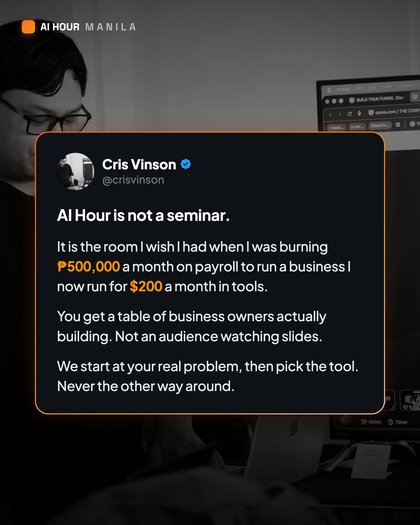 Modeled onHormozi vantage card
 Modeled onTony Robbins RPM
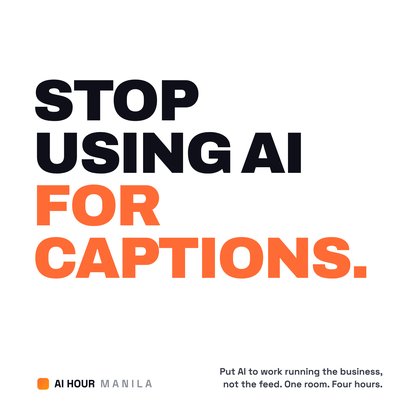 Modeled onStop Using To-Do List
 Modeled onMindvalley story
 Modeled onClone yourself square
2. Pour our story into the proven shape
Next we had Claude take each proven structure and fill it with our brand, our photos, and our message. Proven skeleton, our story, a finished on-brand ad. The structure had already earned its results elsewhere. We were not betting on a layout, only on the message inside it.
3. Ship a matrix, not one ad
We did not make one ad. We had Claude generate a matrix: five structures times three message angles, fifteen creatives. That way the market picks the winner, not our ego. The 16-cent lead was the survivor of fifteen tries. Betting on a single favorite would have cost us triple.
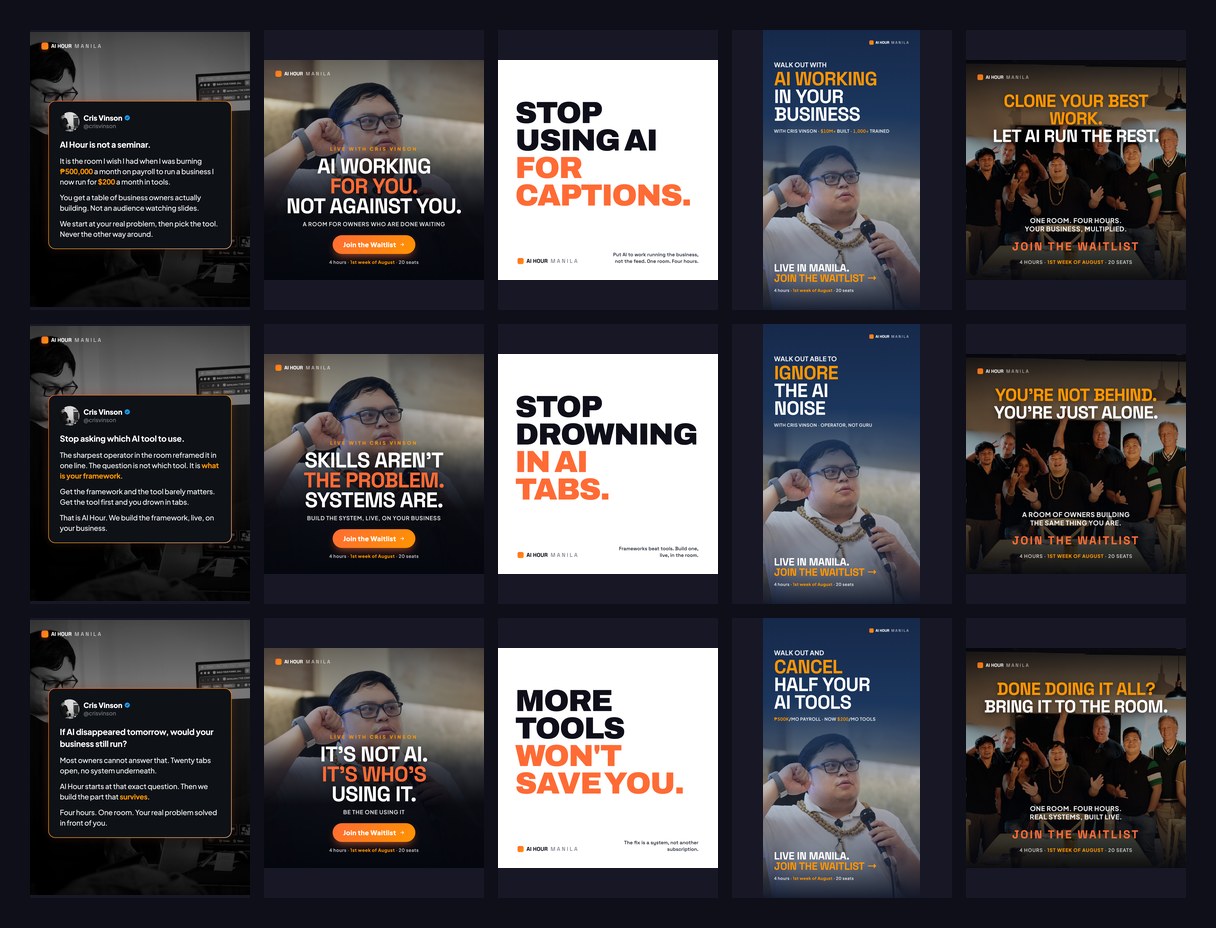
4. Flip the objection into the headline
We had Claude mine our own campaign notes for the audience's number one documented objection. It was written right there: I am not techy. We did not argue with it. We agreed with it, then flipped it into permission.
“I am not techy.”
Not techy. Still using Claude.
5. Mine lines that already landed in the room
The best line in the whole campaign was not written for the ad. It came from a workshop stage, months earlier, where I had watched a room lean in when I said it. We had Claude pull that proven line out of our own deck and reel scripts and move it into the ad copy.
Stop using AI like a search bar. Start directing it like a founder.From our workshop deck, promoted into the ad. Proven in a live room before it ever paid for a click.
6. Keep the promise after the click
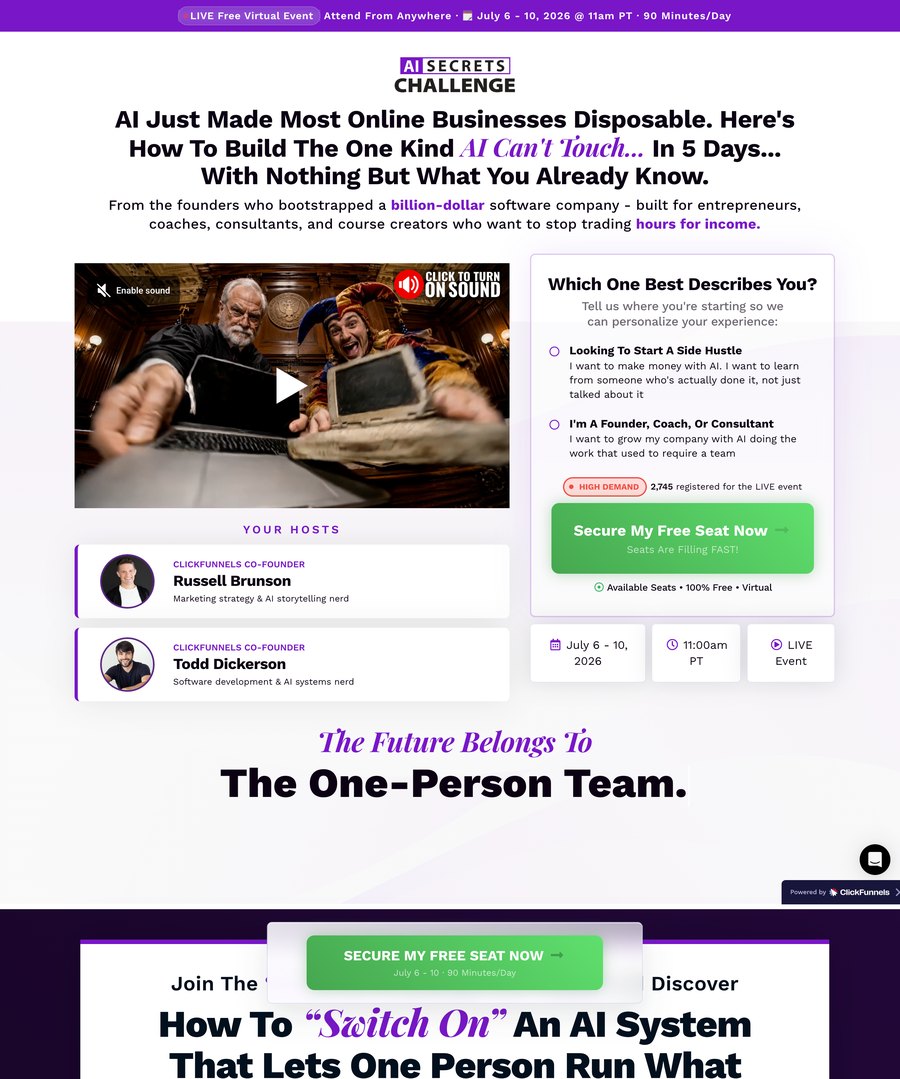
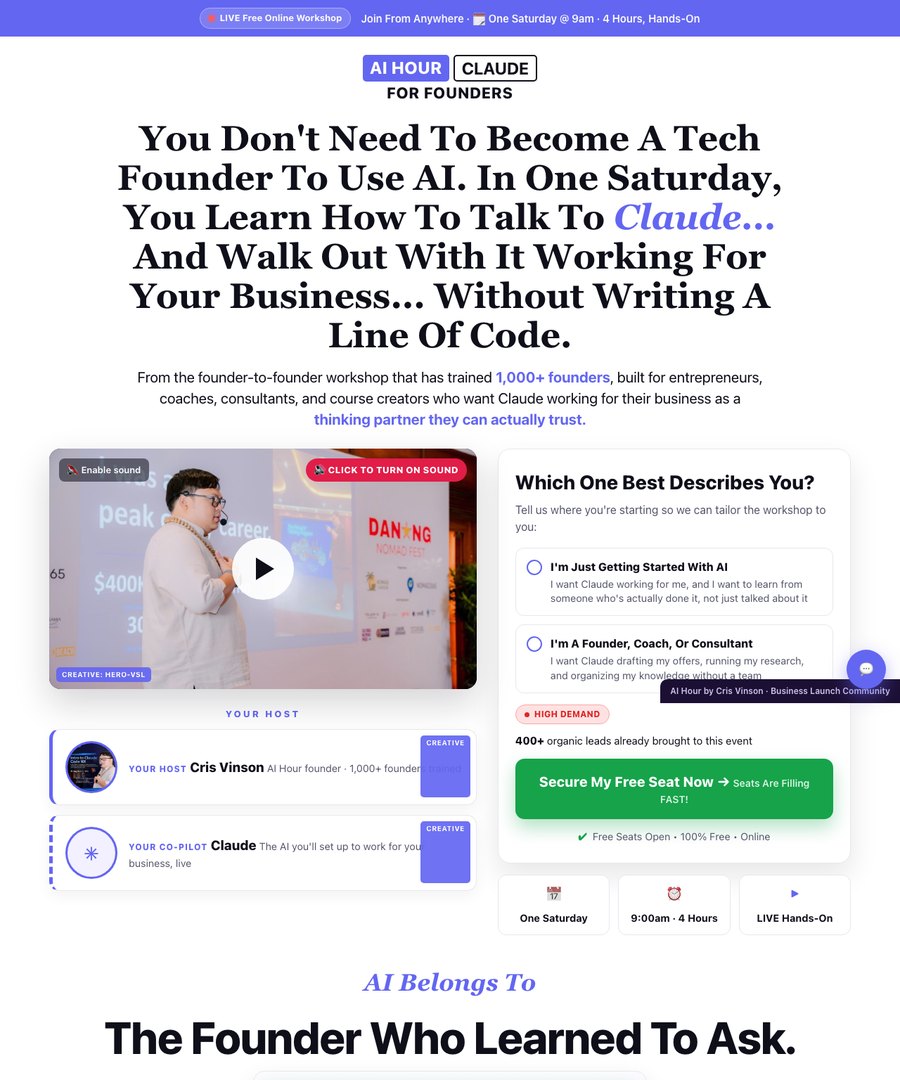
We had Claude build the registration page by modeling a proven control page, then run a compliance audit on it. The page had to keep the ad's exact promise: free only, one call to action, real photos, no bait and switch. A page that keeps its promise converts better, and Meta rewards that with cheaper leads.
7. Hold the voice
Claude enforced the same rules on everything it produced, so the ads read like a real operator instead of generic AI output.
The result, and the number that actually matters
That system produced leads at about 16 cents each in a market where most people pay five to ten times that, run by one person directing Claude with no team and no agency retainer.
Now the honest part. The cheap lead is not the number that actually matters. A free event fills up with people who never show. If you only celebrate the cheap lead, you will spend real money scaling a crowd that never buys.
The real metric is the cost per person who actually shows up, and the share of them who are real founders. Watch the number after the number.
You can run this yourself
You do not need a creative team. You do not need an agency. You do not need to be technical. Every move above was an instruction in plain language to a tool you can open right now.
Reverse-engineer what already works. Pour your story into a proven shape. Ship a matrix instead of a bet. Mine your own notes for the objection and the line that already lands. Keep the promise on the page. Hold the voice. That is not a special skill. That is direction. The old way was to hire it. The new way is to direct it.
Frequently asked questions
How much did the leads actually cost?
About 9.85 pesos each, which is roughly 16 US cents, on Meta with broad Philippines targeting for a free workshop. For this market that is five to ten times cheaper than a typical lead.
Do you need to be technical to run this?
No. Every step was a plain-language instruction given to Claude. You bring the business and the judgment. Claude does the design, the copy, and the quality checks.
Did you use an agency or a creative team?
No. There was no agency, no designer, and no copywriter on a retainer. It was one operator directing Claude, which acted as the creative department, the strategist, the copywriter, and the quality control.
Is a cheap lead the right thing to measure?
No. A free event attracts people who never show up. The number that matters is the cost per person who actually shows up and the share of them who are real founders. A cheap lead that becomes a no-show is not a win.
Can I really do this myself with Claude?
Yes. The whole system is a sequence of instructions: reverse-engineer a proven ad, pour your story into its shape, ship many variants, flip your customer's objection into the headline, reuse lines that already worked, and keep the page promise matched to the ad. All of it is direction, not code.

