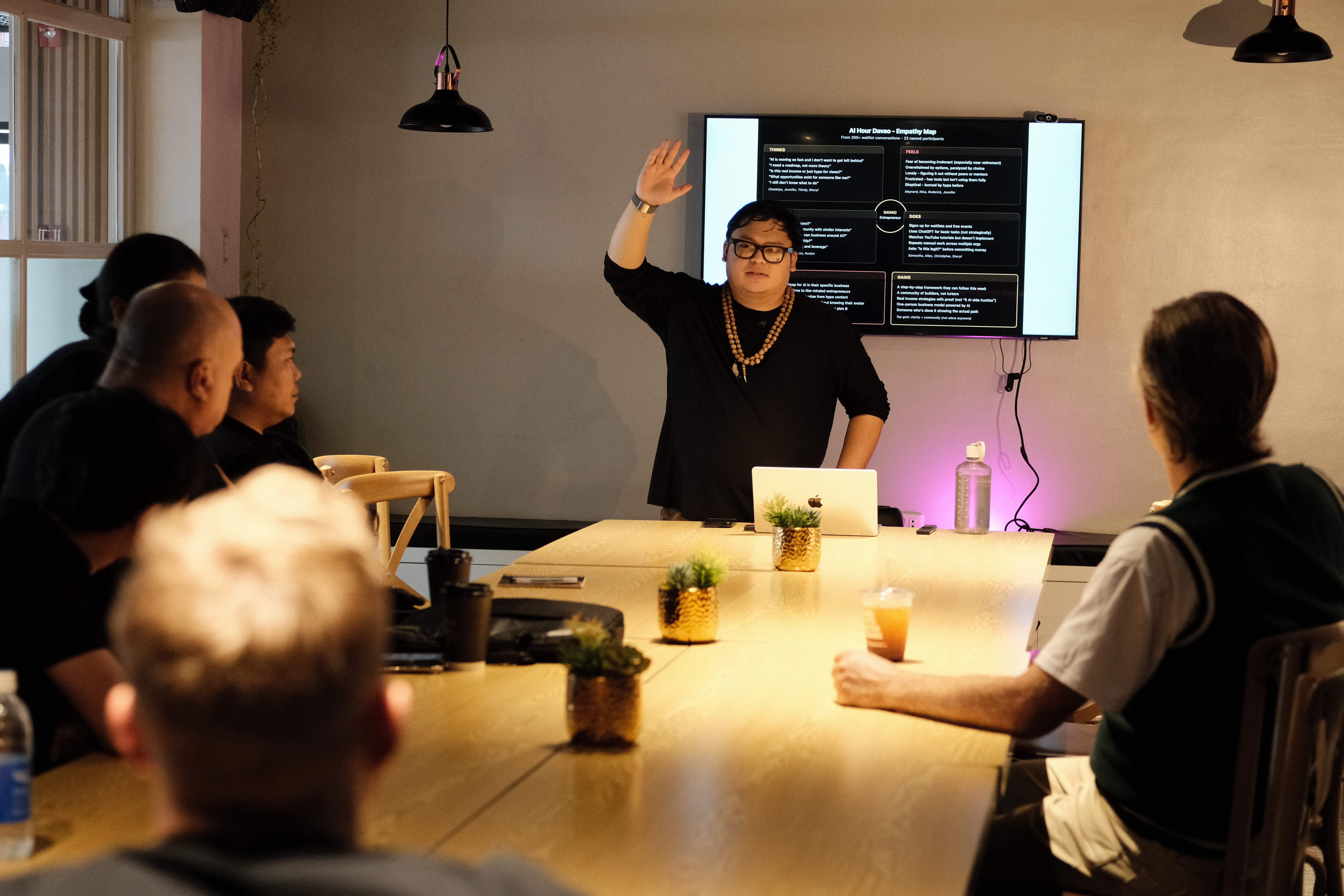
Cris Vinson leading an AI strategy session with business owners gathered around the table
Private AI Agentic Incubation

Build AI that knows the job.

A private implementation engagement that turns one recurring process into a governed AI agent your team can operate.

Apply Now

This work starts after the demo. The agent has to know the business, use the right tools, respect the rules, and survive real work.

$10M+Revenue impact across client and owned projects
1,000+Founders, professionals, and business owners trained

The founder is still the integration layer.

You have AI tools. You may even have useful prompts. But the business still waits for you to provide context, check the output, and move the work forward.

That is not an AI workforce. It is a faster way to keep every decision in your own head.

Repeated contextEvery conversation begins by teaching the AI who you are again.
Generic outputThe tool writes, but it does not understand the judgment behind the work.
Disconnected actionGood answers stay trapped in a tab instead of entering the workflow.
Founder review debtAI creates more material, while the approval bottleneck grows.
A chatbot answers. An agent owns a job.The difference is a defined role, trusted knowledge, controlled tools, clear guardrails, and a human handoff.
Client case study

Freeman unified the business before adding AI.

His tools were consolidated first. Then his books, talks, emails, and business context could become the grounding layer for specialized assistants that scale his voice.

Freeman, Travel to Transform

From fragmented tools to an agentic roadmap.

Squarespace, Kajabi, and other tools were consolidated into GoHighLevel, with quiz segmentation, nurture automation, and one-to-many follow-up supporting his launch.

The next layer organized his books, talks, past emails, and business context into a knowledge-base roadmap. Freeman later described building multiple AI assistants at his own pace and connecting his GoHighLevel API with Claude Code.

The operating system came first. The AI layer followed the real context, decisions, and voice already inside the business.

“He preserved my authenticity as well.”Freeman, International Speaker and Founder of Travel to Transform

The Agent Job Contract.

A reliable agent is not a prompt. It is five decisions that must agree before the work can be trusted.

What gets installed

Four assets turn one painful process into operating capacity.

The engagement produces a working system your team can inspect, govern, and improve after the implementation ends.

Knowledge layer

The source material, examples, customer context, and authority rules the agent can reason from.

Organized sources and a clear source hierarchy

Job contract

The role, outcome, inputs, limits, review standard, escalation rules, and human handoff.

An observable definition of completed work

Working agent

The role implemented in the right environment and connected to the tools required for controlled action.

Agent, reusable skills, workflow, and QA cases

Operating handoff

The review rhythm, documentation, ownership, and expansion logic the team can continue using.

Team transfer and an expansion roadmap

The contract becomes a working system.

Implementation happens inside the real process, with the people who will own the standard after handoff.

Inspect

Map the real process.

The first job is chosen with the people doing the work, using leverage, available knowledge, and the cost of failure.

Build and test

Challenge real output.

Operators run real cases, expose weak assumptions, and decide where human judgment stays.

Transfer

Leave the team in control.

The agent, review standard, and operating rhythm are documented and handed over.

Working agent

Alice handles the conversation.

Cris's AI receptionist answers questions, asks follow-up questions, and books calls.

Alice works because the human part was designed first: the intention, response rules, quality standard, and handoff. The agent carries those decisions without removing human ownership.

Operating proof beyond AI.

These published client videos show the broader systems work behind workflow improvement, cost reduction, and recurring-revenue growth.

Josh, Agency OwnerCost reductions that created room to scale.
Kirsty, Company DirectorThree years of workflow improvement and proactive support.
Kevin, Agency OwnerFive years of product expansion and recurring-revenue growth.

This is for operators ready to delegate real work.

The best starting point is not enthusiasm about AI. It is a recurring business process, enough source material to teach it, and a person willing to own the operating standard.

You are likely a fit when:

  • You run a service, agency, consultancy, program, or operating team.
  • You already use AI, but the value is trapped in isolated chats and individual habits.
  • You can name recurring work that is slow, expensive, inconsistent, or founder-dependent.
  • You have real documents, examples, customer context, and decisions to ground the agent.
  • You want implementation, governance, and transfer, not another AI overview.

This is not the right fit when:

  • You are looking for a generic chatbot or a folder of prompts.
  • You cannot identify a real workflow or owner for the first agent.
  • You want AI to make unsupervised high-risk decisions.
  • You expect every process to be automated at once.
  • You want a shortcut to avoid learning how quality is reviewed.

The application defines scope before price.

This is a paid implementation engagement, not a free strategy session. One contained agent is different from a connected operating system across a team. The application identifies the first viable job. If the fit is real, the next call defines the delivery boundary, ownership, timeline, and investment before a proposal is made.

Review

Your workflow, source material, ownership, and readiness are checked for fit.

Working call

The first job, acceptable output, tools, guardrails, and handoff are mapped.

Scope

The proposal states the deliverables, owners, timeline, and investment before work begins.

Before you apply.

No. You need to understand the job, the acceptable output, and the situations that require human judgment. Technical implementation is built around that operating knowledge.

Bring one recurring workflow, the documents and examples behind it, and the person who will own the operating standard.

The engagement focuses on replacing avoidable repetition and increasing human capacity. Ownership, judgment, relationships, and accountability remain explicit parts of the system.

We define permissions, source boundaries, edge cases, test cases, review standards, and escalation rules. Higher-risk actions keep a human approval checkpoint.

Timing depends on the workflow, knowledge readiness, integrations, and number of roles. The engagement is structured as a focused implementation cycle, not an open-ended AI retainer.

Application

Apply for AI Agentic Incubation.

This is not a generic discovery call. The application helps identify whether the process, knowledge, tools, and ownership are ready for an agentic implementation.

Name the real workflow, not a broad ambition.
Show us what the team uses and where the process breaks.
If the fit is real, the next conversation defines the first deployment.
Apply Now